Experiences in health emergency disaster risk management using a whole of society approach in the context of the COVID-19 pandemic
#ResourceNotFound: WKCResources, ProjectImplementationsHeading#
#ResourceNotFound: WKCResources, ProjectImplementingPartnersHeading#
Lead research institution: Hiroshima University
Other participating research institutions: University of Occupational and Environmental Health, Japan (Japan), The Catholic University of Korea (Republic of Korea), Ritsumeikan Asia Pacific University (Japan), Mongolian National University of Medical Sciences (Mongolia), Johns Hopkins University (USA), Universita del Piemonte Orientale (Italy), Thailand Ministry of Public Health (Thailand), Japan National Hospital Organization (Japan), Yodogawa Christian Hospital (Japan)
Principal investigator: Dr Odgerel Chimed-Ochir
#ResourceNotFound: WKCResources, ProjectLocationOfResearchHeading#
Global
#ResourceNotFound: WKCResources, ProjectTotalBudgetHeading#
Background
The COVID-19 pandemic has had profound impacts on national health systems in many countries. In order to respond to a rapid surge in demand for health services, countries were forced to modify national health policies, strategies and plans. All countries have different health systems, such as health workforce, infrastructure, and service delivery, and responded to the pandemic differently, depending on national health emergency and disaster risk management (Health EDRM) strategies and capacity. Hence, sharing experience and lessons learnt from how each country responded to the pandemic is useful to develop a resilient health system.
This research project aimed to investigate national-level responses to the COVID-19 pandemic and best practices, lessons learnt, and specific changes made to the existing Health EDRM system, with an emphasis on human resources.
Methods
This project involved a scoping review and series of case studies.
Scoping review
A scoping review of national responses to human resource management during the COVID-19 pandemic was conducted. Relevant scientific articles were searched using Medline, Web of Science, Scopus, EBSCO, and TRIP Medical Database to address 1) any changes to national strategies on health workforce shortage and/or occupational safety of healthcare workers (HCW), 2) advantages and disadvantages from the changes, and 3) impact of the changes on human resource management.
Case Studies
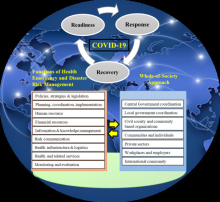
Supplementary to the scoping review, case studies of seven countries were carried out in South Korea, Japan, Iran, Italy, Thailand and the United States. The case studies aimed to highlight how each country responded to the pandemic with specific focus on three functions from the Health EDRM framework [1], including human resource management, logistics and health service delivery. Researchers from each participating institution answered a questionnaire developed by Hiroshima University.
[1] World Health Organization. (2019). Health emergency and disaster risk management framework. World Health Organization. https://apps.who.int/iris/handle/10665/326106. License: CC BY-NC-SA 3.0 IGO
Results
Scoping reviews
20 papers identified through the scoping review indicated that there were five commonly implemented strategies to manage human resource challenges at national level, including 1) financial coordination mechanism, 2) relaxing standards and rule, 3) redeployment/task shifting/skill mix, 4) recruiting volunteer/fast tracking medical students, and 5) using other resources of workforce. Read the JHU scoping review paper here.
Case Studies
Single- and cross-case analyses identified several national policies commonly implemented during the pandemic to manage healthcare workforce shortage. Redeployment of HCWs at national, regional, and organisational level was the most used strategies. Other strategies included recruitment of volunteer workers, fast tracking medical students, recalling inactive healthcare workers, recruited returnees, and additional budget allocation to hire more HCWs. These strategies tended to relax some quality standards which aimed to increase the number of workforce and to reduce the HCW’s workload. However, these strategies were short-term solution and there were concerns over safety implication and financial / operational sustainability for long-term.
Case study analysis also identified various national policies for occupational safety for HCWs. These policies were primarily implemented at organisational level, such as creation of psychological support teams, workplace improvements, and support for daily essentials (e.g. financial incentives and childcare support). All of these strategies were found to be effective to prevent the burnout of HCWs, but their sustainability and operational reality in future emergencies requires further investigation.
Global Implications
This research project found that many national governments came to similar strategies on how to deal with human resource shortages. However, most of the strategies identified in this project were from high-income or upper middle-income countries as information on low or low-middle income countries were scarce. This limits the findings to be generalisable in low-resource settings. Nevertheless, the best practices and lessons learnt may be useful by adjusting to health system structure and resource setting. For instance, HCW redeployment strategies may be applied to many counties by relaxing HCW mobility policies to enable HCWs to work across geographical boundary in a country. Involving volunteers with good coordination mechanisms may be also considered to alleviate the HCW workload in low-setting countries. It is crucial to learn from experiences and share the best practice to feed into development of better policy responses in order to increase future disaster resilience.
Implications for Kansai
The local healthcare system and healthcare organisation in the Kansai region may also benefit from the best practices and lessons learnt from the country experience found in this project since COVID-19 is a pandemic that affects every part of the planet. It is also important to highlight and share good disaster management practice from the Kansai regions to the world.
Publications
Scoping Review
- Chimed-Ochir O, Amarsanaa J, Yumiya Y, Kayano R, Kubo T. (2023). Impact of Covid-19 in Health Emergency and Disaster Risk Management System: Healthcare Workforce Management in Covid-19. Prehospital and Disaster Medicine, 38(S1), S203-S203. doi:10.1017/S1049023X23005198
- Mitchell AJ, Kubo T, Chang AH, Ochir OC, Salerno A, Yumiya Y, Barnett DJ, Nakase K, Hsu EB. (2022). Disaster and public health emergency health data collection and management: A scoping review. Am J Disaster Med. 2022 Fall;17(4):277-285. doi: 10.5055/ajdm.2022.0443. PMID: 37551899.
Case Studies
- Park J, Min J, Song J-H, Park MY, Yoo H, Kwon O, Yang M, Kim S, Lee J, Myong J-P. The COVID-19 Pandemic Response and Its Impact on Post-Corona Health Emergency and Disaster Risk Management in Republic of Korea. Sustainability. 2023; 15(4):3175. https://doi.org/10.3390/su15043175
- Ghotbi N. The COVID-19 Pandemic Response and Its Impact on Post-Corona Health Emergency and Disaster Risk Management in Iran. Sustainability. 2022; 14(22):14858. https://doi.org/10.3390/su142214858
- Lamberti-Castronuovo A, Parotto E, Della Corte F, Hubloue I, Ragazzoni L, Valente M. The COVID-19 pandemic response and its impact on post-corona health emergency and disaster risk management in Italy. Front Public Health. 2022 Oct 31;10:1034196. doi: 10.3389/fpubh.2022.1034196. PMID: 36388364; PMCID: PMC9659979.
- Ishimaru T, Shimizu S, Teshima A, Ibayashi K, Arikado M, Tsurugi Y, Tateishi S, Okawara M. The Impact of COVID-19 Outbreak on Health Emergency and Disaster in Japan. Sustainability. 2022; 14(23):15686. https://doi.org/10.3390/su142315686
- Chen AP, Hansoti B, Hsu EB. The COVID-19 Pandemic Response and Its Impact on Post-Pandemic Health Emergency and Disaster Risk Management in the United States. Sustainability. 2022; 14(23):16301. https://doi.org/10.3390/su142316301